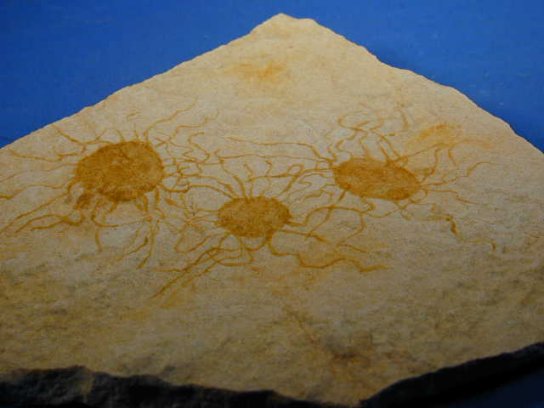
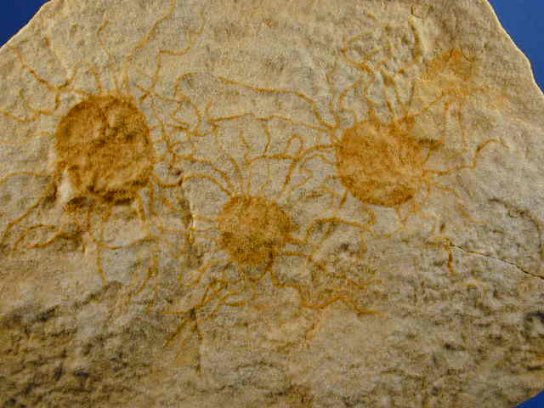
Name: Phylum: Cnidaria; Class: Scyphozoa; undescribed jellyfish
Age: Middle Cambrian
Size (25.4mm=1 inch): Matrix: 8.6 by 8 inches
Location: Krukowski Quarry, Mount Simon Sandstone Outlier, Mosinee,Wisconsin
Code: DD412
Price: $275.00 - Sold
|
Being comprised
entirely of soft tissue (living jellyfish are about 95 % water),
unlike animals with exoskeletons (e.g., trilobites) or skeletons
(vertebrates), jellyfish fossils are body fossils that are impressions
of the jellyfish. Such fossil impressions are rare, especially from
the Cambrian. Note that these jellyfish have tentacles in the familiar
radial symmetry of all Cnidarians. Jellyfish were some of the most
ferocious predators of the Cambrian marine environment. These fossils
are almost surely the result of a mass These jellyfish,
three of them on the plate, come from a particular horizon in the
Mount Simon Sandstone formation that also yields facinating Diplichnites,
huge Jellyfish (Medusae) and Climactichnites. Jelly fish body fossils
are incredibly subtle, and therefore this specimen has been subtly
stained. Phylum Cnidaria (anemones, corals, jellyfish and sea pens) are among the most ancient animals and has one of the longest fossil histories of metazoans. Though simple in body form, they remain ubiquitous and widespread in modern marine environments. The earliest forms in the fossil record appear in Ediacarian fauna of Southern Australia, which dates to the Precambrian some 600 million years ago. This is clear testament that old and simple animals can be enormously successful. |
 stranding
on an ancient Cambrian beach, possibly caused by a storm surge.
stranding
on an ancient Cambrian beach, possibly caused by a storm surge.